

STEEL DEMAND FORECASTING & INVENTORY OPTIMIZATION

Global Steel Industry
The steel production volume is estimated to reach 2000 million tonnes in 2024, growing at a CAGR of 4.50% globally. Multiple factors like rising population growth with an increase in urban population, growing automobile sector and increased spending on infrastructure projects are the cause of rising demand for steel. China is also a major contributor to the global steel industry. India is the fastest-growing market for steel with an increase in urbanisation, industrialization and infrastructure.
Biggest Challenges in steel demand forecasting
- Derived demand as steel is an intermediate good makes forecasting difficult.
- Affect of macro economic indicators and uncertainty in global economy has decoupled demand from economic growth.
- Long range forecasting methods such as econometric approach and intensity of usage approach are complex and have limitations
- Bottom up forecasting and demand planning largely absent thus resulting in incomplete S&OP
- Commodity price fluctuations and it’s affect on inventory optimization and decision making.
Solutions
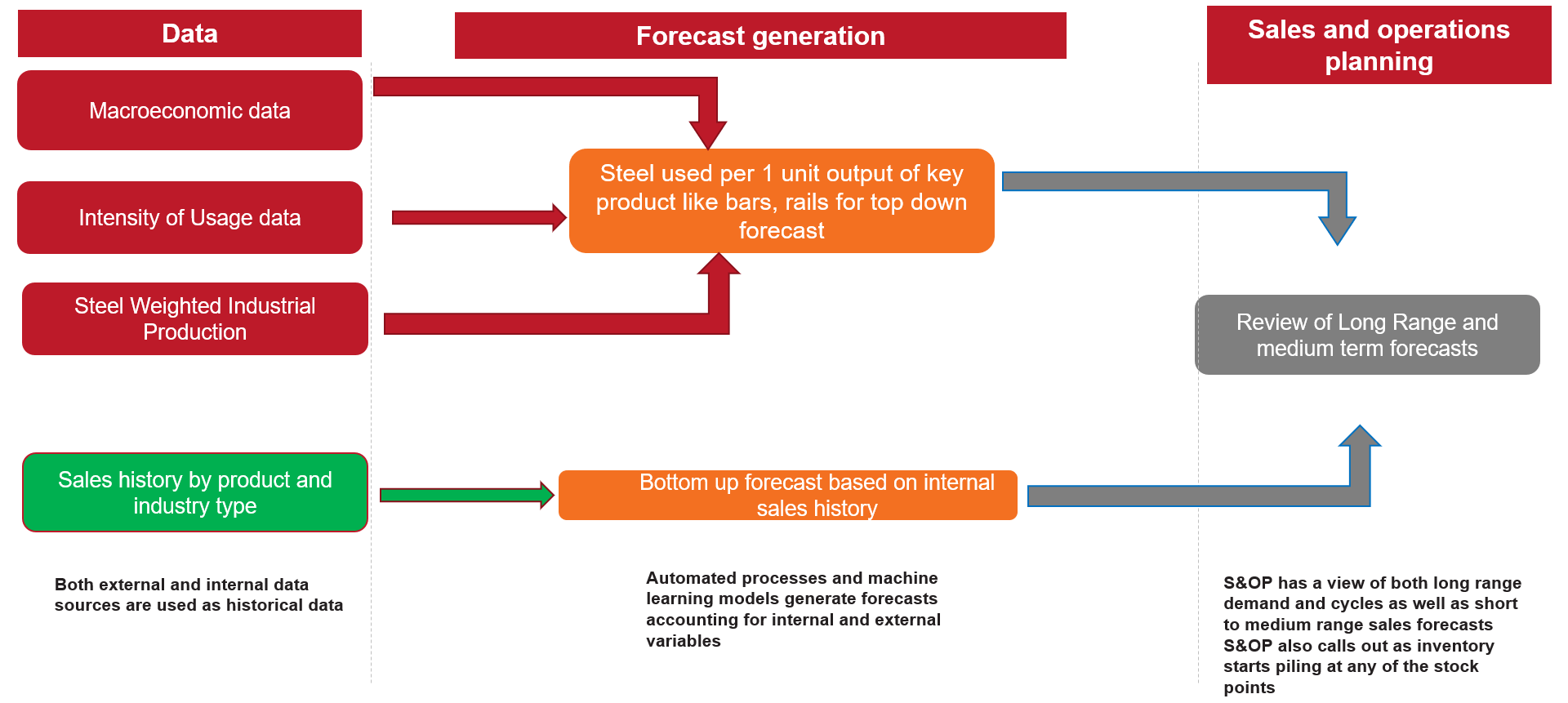
- Create a holistic approach to overall demand forecasting and S&OP that is optimization of top down and bottom up planning.
- Higher forecast accuracy by including external and internal variables for product categories leading to reliable RM buying forecasts.
- Balancing long range forecasts with mid range sales demand for capacity and capital allocation decision making.
- High degree of ease of use & automation in overall n planning resulting in lesser workloads.
- Ability to optimize inventory by performing scenario analysis on changing commodity prices.
Our Praposed Solution
Inventory optimization methods
- Real time data inputs from all stock points and yards to monitor movement
- Monitoring of customer commitment versus actual confirmed orders
- Dynamic safety stock calculation at different stockpoints
- Use of optimization software to evaluate transportation costs from high stock yards to demand point
- Evaluate commodity price fluctuation versus hedging to prevent excess stock build up
- Perform network optimization of entire supply chain periodically to evaluate supply chain efficiency and identify opportunities for inventory reduction
Benefits Achieved
- Best in class companies carry 4 days RM
- Best in class companies have 5% forecast error
- Reduction in FG inventory by 10% using network optimization